
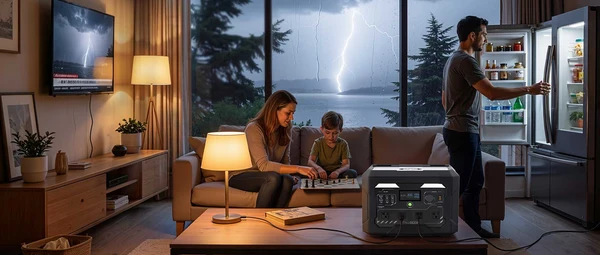
When a hurricane approaches, one of the most important questions homeowners face is how to maintain essential electricity during a power outage. Strong winds, flooding, and damaged power lines can leave homes without grid electricity for hours or even several days. A reliable battery backup system can help keep critical appliances running, but choosing the right size requires an understanding of household power consumption.
The answer to how much battery capacity a home needs during a hurricane depends on several factors, including the appliances you want to operate, how long the outage may last, the power each device consumes, and whether you have access to solar panels or another charging source. By calculating your actual energy needs, you can select a battery system that provides practical backup power without paying for unnecessary capacity.
Understanding Battery Capacity and Power Consumption
Battery capacity is generally measured in kilowatt-hours (kWh), while appliance power consumption is often listed in watts (W) or kilowatts (kW). A battery rated at 10 kWh, for example, can theoretically provide 10 kilowatt-hours of energy. However, the usable capacity may be lower because battery systems typically reserve some energy to protect the battery and improve its lifespan.
Power consumption also varies between appliances. A refrigerator may use relatively little energy over a full day because its compressor cycles on and off, while an electric stove or clothes dryer can consume substantial power when operating. This difference makes it important to calculate energy use based on actual operating time rather than simply adding the wattage of every appliance in the house.
For example, if a refrigerator averages 100 watts while operating and runs for approximately 10 hours of equivalent active consumption per day, it could use about 1 kWh daily. A few LED lights might consume only a fraction of that amount, while a portable air conditioner could require several kilowatt-hours depending on its efficiency and usage.
Identify Your Essential Appliances
During a hurricane outage, most households do not need to power every appliance. Instead, homeowners typically prioritize essential equipment that supports safety, communication, food storage, and basic comfort.
Common backup priorities include:
- Refrigerator and freezer
- LED lights
- Wi-Fi router and modem
- Mobile phone chargers
- Medical equipment
- Security systems
- Television or radio
- Small fans
- Sump pumps
- Garage door openers
- Essential kitchen appliances
Heating and cooling requirements can dramatically change battery needs. A small fan may use relatively little electricity, while central air conditioning can consume significant energy. Electric heating systems can require even more power, making whole-home battery backup considerably larger and more expensive.
The first step is therefore to create a list of appliances that must remain operational. Then, estimate how many watts each appliance uses and how many hours per day it will run.
Calculate Your Daily Energy Requirements
A simple calculation can help estimate energy consumption:
Watts × Hours of Use ÷ 1,000 = Kilowatt-Hours Used
Suppose you want to run a 100-watt refrigerator for an equivalent of 10 hours per day. The calculation would be:
100 × 10 ÷ 1,000 = 1 kWh
If you also operate 20 watts of LED lighting for five hours, that adds:
20 × 5 ÷ 1,000 = 0.1 kWh
A 50-watt internet and communication setup running for 12 hours would consume:
50 × 12 ÷ 1,000 = 0.6 kWh
Together, these devices would require approximately 1.7 kWh per day. Additional appliances would increase the total.
Remember that appliance labels do not always reflect real-world consumption. Refrigerators, freezers, pumps, and air conditioners cycle on and off. Using a home energy monitor or smart plug with energy measurement capabilities can provide a more accurate estimate before hurricane season begins.
Estimate How Long the Outage Could Last
The duration of a power outage is one of the biggest factors when determining how much battery capacity a home needs during a hurricane. A system designed for a six-hour outage will have very different requirements from one intended to provide backup power for three days.
For example, if your essential appliances consume 5 kWh per day and you want three days of backup, your basic energy requirement is:
5 kWh × 3 days = 15 kWh
However, buying a battery with exactly 15 kWh of advertised capacity may not be enough. Conversion losses, reserve capacity, temperature, battery degradation, and unexpected energy use should all be considered. A practical backup system may therefore require additional capacity above the calculated minimum.
If your area frequently experiences extended outages, consider a modular battery system that allows you to expand capacity later. This approach can provide flexibility while avoiding the cost of purchasing a very large system immediately.
Consider Peak Power and Starting Loads
Battery capacity is not the only specification that matters. You must also consider the inverter’s continuous and peak power output.
Some appliances require a higher surge of electricity when they start. Refrigerators, freezers, pumps, and certain motors can have significant startup demands. A battery system may have enough total energy capacity but still fail to start an appliance if its inverter cannot provide sufficient peak power.
For this reason, check both the running wattage and starting wattage of important appliances. If several devices may start simultaneously, the backup system should have enough inverter capacity to handle those combined demands.
This is particularly important for homeowners who want to operate pumps, well systems, large refrigerators, or air-conditioning equipment during a hurricane-related outage.
Typical Battery Capacity Ranges
The right capacity varies significantly by household, but general ranges can help with planning.
A small battery system of around 2 to 5 kWh may be suitable for basic emergency needs, such as charging phones, powering lights, operating a router, and supporting small electronics.
A medium system of approximately 5 to 15 kWh can provide more substantial backup power for refrigerators, lighting, communication equipment, fans, and other essential devices. With careful energy management, this range may cover many households’ critical needs during a short or moderate outage.
Larger systems of 15 to 30 kWh or more may be appropriate for homeowners who want extended backup or need to operate higher-consumption appliances. Whole-home backup systems can require considerably more capacity, especially when electric heating, cooling, water heating, or cooking is included.
These ranges are only starting points. Household energy consumption varies widely, so an individual load calculation remains the best way to determine the appropriate system size.
Improve Battery Runtime by Reducing Consumption
Understanding how much battery capacity a home needs during a hurricane is not just about buying a bigger battery. Reducing electricity consumption can significantly extend backup runtime.
Use LED bulbs instead of traditional incandescent lighting. Keep refrigerators and freezers closed as much as possible during an outage. Unplug unnecessary electronics and disable devices that consume standby power. Charge phones and portable power banks when electricity is available, and use fans strategically rather than running high-energy cooling equipment continuously.
If you have a battery-powered appliance or alternative cooking method, consider using it instead of an electric stove or oven. Similarly, limiting entertainment equipment and other nonessential loads can preserve battery energy for critical needs.
Solar Panels Can Extend Backup Power
A battery provides stored energy, but solar panels can help replenish that energy when sunlight is available after the storm. A solar-plus-storage system may therefore offer greater resilience during extended outages.
However, solar production can be reduced by clouds, rain, debris, and storm damage. It is important not to assume that solar panels will completely replace the need for adequate battery storage. Instead, consider solar generation as a way to extend the duration of your backup system.
A properly configured system can use solar energy during the day while storing excess electricity for nighttime use. This can be particularly valuable when grid restoration takes several days.
Plan for Realistic Emergency Conditions
When determining how much battery capacity a home needs during a hurricane, focus on realistic emergency priorities rather than normal household electricity usage. Most families can significantly reduce their energy consumption during a temporary outage.
Create an emergency load plan that separates appliances into three categories: essential, useful, and nonessential. Essential equipment should receive priority at all times. Useful devices can be operated only when sufficient battery power is available, while nonessential appliances should remain disconnected.
It is also wise to test your backup system before hurricane season. Confirm that batteries are fully charged, cables and connections are secure, and everyone in the household understands how to use the system safely.
Final Thoughts
Determining how much battery capacity a home needs during a hurricane requires more than choosing a battery based on the size of your house. The most accurate approach is to calculate the energy consumption of essential appliances, estimate the expected outage duration, account for startup power requirements, and include a reasonable reserve.
For many homes, a battery in the 5 to 15 kWh range may provide useful emergency coverage when energy use is carefully managed. Larger households or homes with substantial electric heating, cooling, pumps, or medical equipment may need significantly more capacity.
The goal is to build a backup system that matches your actual needs. By understanding power consumption and planning ahead, you can make better decisions about battery capacity and improve your home’s ability to remain safe, connected, and comfortable when a hurricane disrupts the electrical grid.